|
|
Institute
of Asian Research 2004 Seminar Schedule |
For more information please call (604)
822-4688 |
Seminars are sponsored by: CAS - Centre
for Australian Studies | CAPRI - Canada Asia Pacific Research Initiatives |
CCR - Centre for Chinese Research | CISAR - Centre for India & South Asian
Research | CJR - Centre for Japanese Research | CKR - Centre for Korean Research
| CPIRD - China Program for Integrated Research Development | CSEAR - Centre
for Southeast Asia Research | PICSA - Program in Inter-Cultural Studies in Asia.
Sessions are typically held in the C.K. Choi Building.
| date&time |
JANUARY
SEMINARS |
location |
|
Tues 6 Jan 12:00 - 1:30 pm |
CENTRE FOR SOUTHEAST ASIA RESEARCH, CENTRE OF INTERNATIONAL RELATIONS, AND INSTITUTE FOR EUROPEAN STUDIES Reflections on East Timor After Independence: Government and Opposition:
An Opposition Leader's Perspective Fernando de Araujo is currently a Member of Parliament in East Timor,
Leader of the Opposition Platform, and founder of an alternative press,
Vox Populi. In 2001, he was elected as the President of Partido Democratico,
the party which won the second largest number of votes in the August 2001
national elections for the Constituent Assembly. During the Second Transitional
Administration, he became a Cabinet Member, as Vice-Minister for Foreign
Affairs. He has been extensively involved as founding member of several
civil society institutions such as Fundacao Haburas (an environmentalorganization),
Talitakum (a weekly magazine), and most recently Vox Populi. Mr. De Araujo
will discuss the obstacles and challenges faced by East Timorese and the
current government. Why is Parliament considered to be inefficient? What
are the problems at the local government level? Mr. de Araujo will discuss
the importance of a strong and healthy opposition in the democratization
process. He will also look at some economic problems that East Timor faces,
in particular the conditions in the villages and districts. He will also
address some aspects of the role of different players in civil society,
including student and youth organizations, environmental NGOs, and the
alternative press |
C.K. Choi Bldg. #120 |
|
Fri 16 Jan 4:00 - 5:30 pm |
THE CENTRE FOR KOREAN RESEARCH Traditional western humanism is based on Hellenism, while Christianity
is rooted in Hebraism. Nowadays, the environmental crisis and ecological
destruction are becoming the focus of much attention. So these issues
have influence on literary criticism. For this reason, it is necessary
to discuss these issues from the contrastive viewpoint of Hellenism and
Hebraism. |
C.K. Choi Bldg. #129 |
|
Mon 19 Jan 12:00 - 1:30 pm |
CENTRE FOR CHINESE RESEARCH The Qing Creation of The Province Professor Guy will report on his study of the development of provincial government in the early Qing. The Qing succeeded as an empire in large part because they built an administrative layer between the court and the local level. There were officials termed "governors" in earlier dynasties, but the Qing governors had more responsibility for the functioning of local administration. The research is partly an institutional history, partly a prosopography of the 500 or so governors who served between 1700 and 1800. |
C.K. Choi Bldg #120 |
|
Wed 21 Jan 3:30 - 5:00 pm |
CENTRE FOR SOUTHEAST ASIA RESEARCH & UBC DEPARTMENT OF GEOGRAPHY Issues of Malay Urbanity: Colonial Constructions / Indigenous Constructions This presentation presents a synopsis of one chapter of a book I am currently writing, tentatively entitled RECONSTRUCTING THE SOUTHEAST ASIAN CITY. Using the example of the construction of the ideas of Malay rurality/urbanity in Malaya during the nineteenth and early twentieth centuries, the paper shows how these ideas have powerfully influenced public policy in the period since 1957. Utilising a review of historical data, this presentation attempts to show that this expatriate constructions of Malays as rural people subverted a strong indigenous tradition of urbanity among Malays. This is further supported by a case study of Malays in Kuala Lumpur City.The conclusion reviews developments in Malay urbanization in the period since 1970 showing that the proportion of Malays living in urban areas has increased rapidly. By 2000 the majority of Malays are now living in urban areas and this development both asserts the ongoing continuity of an urban tradition that has never been lost and new indigenous constructions of Malay urbanity. |
Geography Building Rm. 212 |
|
Tues 27 Jan 7:00 pm |
CENTRE FOR KOREAN RESEARCH AND DEPT. OF ASIAN STUDIES Koryô kayo are songs from the Koryô period (918-1392) that
give direct expression to a broad cross-section of the Korean people.
By turns earthy, passionate, wistful, and celebratory, they offer a stark
contrast to the more formal and conceptual verse written in Chinese by
Korean scholar-bureaucrats. One such song, "Kashiri," is a precursor
of modern Korea's best-loved poem, "Azaleas."Scholar, poet,
and raconteur, Kevin O'Rourke is our leading all-around translator of
Korean literature into English, with numerous volumes of translations
to his credit. A native of Ireland, he has lived in Korea since 1964.
He obtained a Ph.D. at Yonsei University in Seoul and teaches at Kyunghee
University. |
C.K. Choi Bldg. # 120 |
|
Thurs 29 Jan 11:30 - 2:00 pm |
INSTITUTE OF ASIAN RESEARCH LUNAR NEW YEAR Celebrate the year of the monkey! Join the Institute of Asian Research
at the C.K Choi Building for a new year celebration. Enjoy foods, music,
crafts and lion dancing on Thursday 29 January from 11:30-2:00 pm. |
C.K. Choi Bldg. # 120 |
|
Fri 30 Jan 12:00 - 1:30 pm |
CENTRE FOR CHINESE RESEARCH AND CENTRE FOR SOUTHEAST ASIA RESEARCH Women and Development Lecture Series: Studies on gender and trade suggest that while women's economic activities
may benefit from trade liberalization, a "gender neutral" approach
to trade policy may fail to capture the different capacities and needs
of women producers. Many women's enterprises are very small (0-5 employees),
and concentrated in traditional, vulnerable sectors (handicrafts, garments
and textiles, food products). Many women producers face constraints in
access to ICT; training; market information; advice on product design
and development; export networks, and finance. In addition, their businesses
may be too small, or too weakly linked with mainstream organizations to
be aware of, or eligible for national or international export facilitation
programsThe presentation will describe a project currently under way in
APEC's (Asia Pacific Economic Cooperation forum) Committee on Trade and
Investment. It focuses on strategies by which very small women producers,
among the most marginalized of groups, could better take advantage of
international markets.Heather Gibb is a senior researcher at The North-South
Institute, an independent research institute based in Ottawa, Canada,
that addresses relations between industrialized and developing countries. |
C.K. Choi Bldg. # 120 |
|
Fri 30 Jan 4:30 - 6:00 pm |
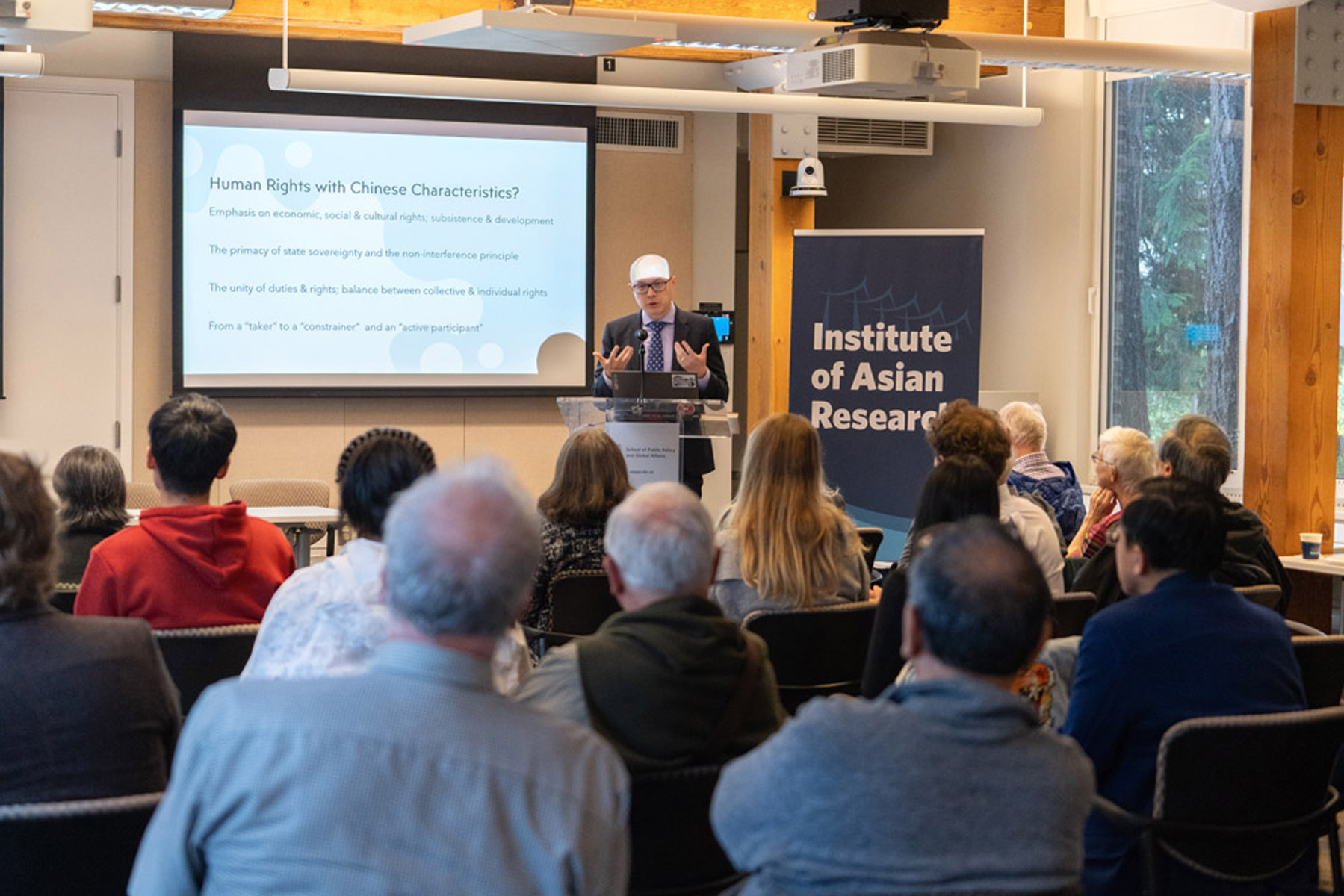
CENTRE FOR JAPANESE RESEARCH Redefining Race in Japan: Domestic Mobilization of Global Human Rights
Frames |
Room #120 |
Seminars in: 1998 / 1999 / 2000 / 2001 / 2002 / 2003 / 2004 / 2005 / 2006 / 2007 / 2008